

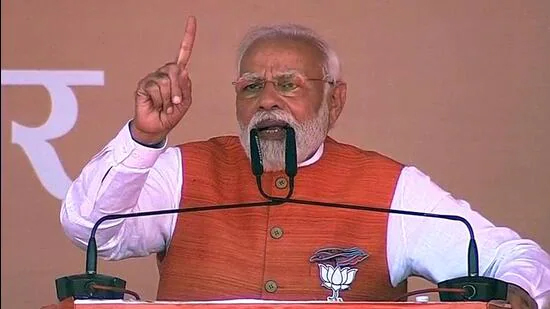
“It is not acceptable that a country like India ends up merely as a market,” he said while addressing a post-budget webinar on ‘Make in India for the World’ that was organised by the Department for Promotion of Industry and Internal Trade (DPIIT).
This was PM’s eighth post-budget webinar explaining the positive impact of the budget on various sectors. In her budget speech, finance minister Nirmala Sitharaman last month said the government is focusing on ₹2 lakh crore productivity-linked incentive (PLI) in 14 sectors as one of its efforts towards ‘Atmanirbhar Bharat’ with for an additional production of ₹30 lakh crore in the next five years besides creating 6 million new jobs. The Union Budget also gave tax incentives to boost domestic startups.
PM Modi said in PLI for large scale electronics manufacturing, the target of ₹1 lakh crore worth of production was achieved in December 2021. Many other PLI schemes are in the important stages of implementation, he added.
This year’s budget has given significant importance to micro, small and medium enterprises (MSMEs) through credit facilitation and technology upgradation, the Prime Minister said.
The budget has also focused on developing new railway logistics products for farmers, for large industries and MSMEs. The integration of postal and railway networks will solve the problems of connectivity in small enterprises and remote areas. He said the regional manufacturing ecosystem can be strengthened by using the model of PM DevINE, which has been announced for the north-east region. Similarly, reforms in the Special Economic Zone Act will provide a boost for exports.
The Prime Minister also pointed at positive factors such as the demographic dividend of young and talented population, democratic set up and natural resources to realise the ‘Make in India’ dream with determination. He said the Indian industry should strive for “zero defect-zero effect on environment” to become global manufacturing hub.
“Atmanirbharta is all the more important if we see through the prism of national security,” he said, adding that manufacturing is the 15% of India’s GDP (gross domestic product), but there are infinite possibilities before ‘Make in India’ and India should work with full strength to create a robust manufacturing base.
He gave examples of new demand and opportunities in sectors such as semiconductors and electric vehicles (EVs), where manufacturers should move with a sense of removing dependencies on foreign sources. Similarly, sectors such as steel and medical equipment need to be focussed upon for indigenous manufacturing, he said.
PM Modi also stressed on ‘vocal for local’, especially during Indian festival seasons, instead of depending on imports. “Take pride in the products your company makes and instill this sense of pride in your Indian customers as well. For this, some common branding can also be considered,” he said.
The Prime Minister further highlighted the need to find new destinations for the local products. He exhorted the private sector to enhance spending on R&D and to diversify and upgrade their product portfolio.
Referring to declaration of 2023 as International Year of Millets, the Prime Minister said, “The demand for millets is increasing in the world. By studying the world markets, we should prepare our mills in advance for maximum production and packaging.”