

BRAMPTON: Everyone deserves a safe and stable place to stay but despite this, many Canadians live in fear of violence daily. For women and children facing violence, the impacts of COVID-19 have been severe. Around the world, rates of gender-based violence have increased, shining a light on the need to address gaps and ensure that no one is left behind.
MP Sonia Sidhu is the Vice-Chair of the Standing Committee on the Status of Women, where a study just wrapped up examining Intimate Partner and Domestic Violence in Canada. Witnesses clearly stated that we must continue to apply a gender and diversity lens to everything we do, and foster safer spaces for women and their children to thrive..
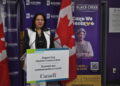
Earlier this month, MP Sidhu met with Inspector Lisa Hewison from the Peel Regional Police Intimate Partner Violence (IPV) unit and Shelina Jeshani from the Catholic Family Services of Peel – Dufferin to speak about their collaboration at the Safe Centre of Peel. They provide integrated care for families and women experiencing IPV, and barriers to safe housing is an issue they hear about frequently.
That is why last week, Minister Ahmed Hussen and Minister Marci Ien announced $121.2 million in funding to build and repair shelters, totaling over 430 housing units. This investment will provide shelter beds and transitional housing units to women and children fleeing domestic violence in the GTA, and give hundreds of families the space to rebuild their lives, gain independence, and help their children. The
The federal government is committed to addressing gender-based violence and providing the resources needed to help those in dangerous situations get out. Ensuring that everyone, regardless of where they live or who they are, has a safe place to live and the resources they need to thrive will always be a priority for this government.
While Minister for Women and Gender Equality and Youth Marci Ien said, “the pandemic has impacted us all, and for women and children facing violence, the impacts have been severe. To address this issue, our government is partnering with Women’s Shelters of Canada through the Children Shelter and Transitional Housing Initiative to increase access to safe and affordable housing across Canada. We all must continue speaking up against acts of gender-based violence, listen and learn from survivors, and think about we how we can build a more equal future for everyone.”
Police-reported data (2019):
In Canada in 2019, of the 107,810 people aged 15 and over who experienced intimate partner violence (IPV) 79% were women.Footnote13
As in previous years, 2019 rates of IPV were more than 3.5 times higher among women than among men (536 versus 149 per 100,000 population).
Self-reported data Overall, 44% of women who had ever been in an intimate partner relationship—or about 6.2 million women aged 15 and over —reported experiencing some kind of psychological, physical, or sexual abuse in the context of an intimate relationship in their lifetime (since the age of 15). More specifically, women were significantly more likely than men to have experienced any form of IPV, including physical abuse (23% versus 17%, respectively), sexual abuse (12% versus 2%), and psychological abuse (43% versus 35%).
Women, relative to men, were considerably more likely to have experienced the most severe forms of IPV in their lifetime (since the age of 15): being made to perform sex acts they did not want to perform (8% versus 1%), being confined or locked in a room or other space (3% versus 0.5%), being forced to have sex (10% versus 2%), being choked (7% versus 1%), and having harm or threats of harm directed towards their pets (4% versus 0.8%).
Among people who experienced intimate partner violence in their lifetime (since the age of 15), women are about four time more likely than men (37% versus 9%, respectively) to have ever been afraid of a partner. 55% of women who experienced physical or sexual IPV feared a partner at some point. Being afraid of a partner can indicate intimate partner violence that is more coercive, more severe, and more likely to reflect a pattern of abusive behaviours