


By: Surjit Singh Flora
BRAMPTON, Ontario—Signalling an aggressive and modernized approach to international commerce, the Canadian government on Thursday launched its first-ever Strategic Exports Office, an initiative designed to help domestic companies secure major contracts in highly competitive global markets.
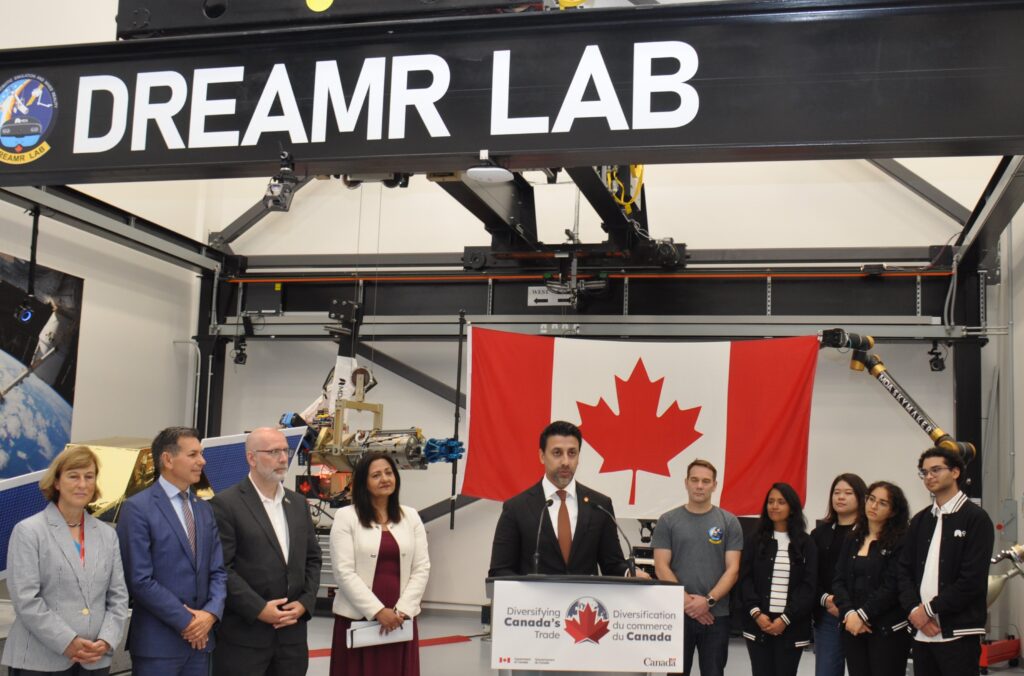
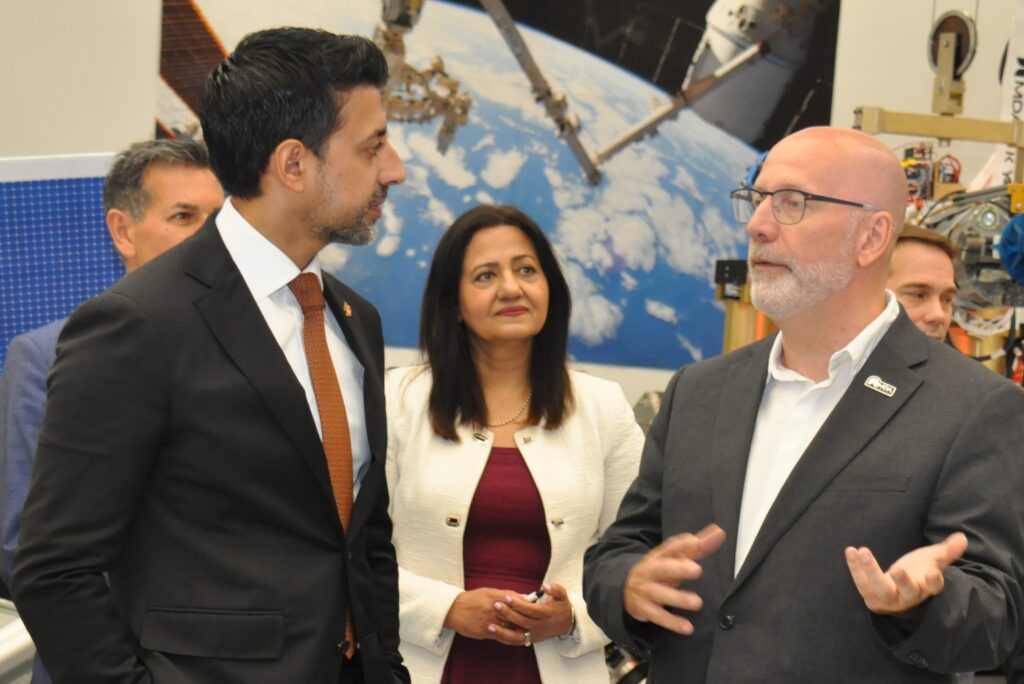
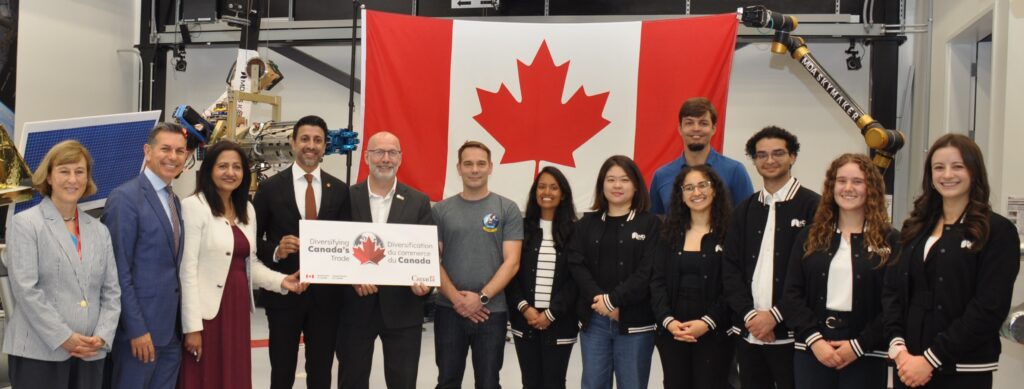
The announcement was made at the Brampton headquarters of MDA Space, a global anchor in the aerospace economy. Minister of International Trade Maninder Sidhu, alongside local MPs Sonia Sidhu and Peter Fonseca, framed the initiative as a necessary evolution for a modern, forward-looking workforce. The new office aims to unify state financing, diplomacy, and strategic advocacy, ensuring Canadian enterprises—and the diverse, highly skilled professionals who power them—can compete effectively against heavily state-backed international rivals.
“Too often they are up against international competitors carried by the full weight of their respective state,” Minister Sidhu said of Canadian businesses. He described the new Strategic Export Office as a “government-level deal maker” designed to break down bureaucratic silos and tear down trade barriers.
The backdrop for the announcement—the Space Robotics Centre of Excellence at MDA Space—served as a potent symbol of Canada’s future-oriented industrial ambitions. Forty-five years after a Canadian team developed the iconic Canadarm, MDA Space CEO Mike Greenley highlighted the company’s ongoing global expansion.
Fueling its ambition to remain a leader in satellite communications and space robotics, MDA Space recently executed two billion-dollar acquisitions, absorbing companies in the United States and France. By January 2027, the company expects its workforce to grow to 5,500 employees operating across 23 countries. Greenley credited the company’s trajectory to decades of forward-looking public policy and praised the current Carney government’s “Build Canada Strong” strategy, which pairs domestic defence investments with aggressive global export goals.
“Every one of those countries is an opportunity to accelerate international trade to the benefit of our company, our colleagues, and Canada,” Greenley said, noting that federal partnership serves as a vital “channel to market.”
The government’s strategy reflects a broader shift toward an egalitarian, globally integrated economic model, where securing international contracts directly translates into sustainable, high-paying jobs at home. Minister Sidhu pointed to a string of recent commercial victories that have generated over $25 billion in successes for Canadian businesses in the past year.
These milestones include Montreal-based CAE securing flight simulator contracts with Malaysia Airlines and Royal Jordanian, and cybersecurity firm OpenText launching a $165 million expansion across Europe, the Middle East, and Africa. Furthermore, De Havilland recently inked a $69 million deal to modernize Greece’s firefighting fleet, a move that is helping to generate 1,500 new jobs at a cutting-edge manufacturing facility in Alberta.
Sidhu also highlighted the historic Airbus agreement, which saw AirAsia commit to purchasing 150 Canadian-built A220 aircraft. That deal alone sustains an expansive supply chain, supporting roughly 30,000 workers across the country.
As global markets become increasingly competitive, the launch of the Strategic Exports Office marks a definitive pivot for Canadian trade policy. By formalizing and accelerating state-level advocacy, the government is betting that its next generation of innovators and workers will not only build the technologies of the future, but successfully sell them to the world.