

The motion was carried with all ruling Liberal Party members supporting it, and crossed the majority threshold in the 338-strong chamber with the support of the New Democratic Party (NDP). The opposition Conservative Party and the Bloc Quebecois opposed it, while the Greens abstained. The final count was 185 votes for and 151 against.
The Emergencies Act was invoked on February 14, as truckers protesting Covid-19 related restrictions including a cross-border mandate, occupied Canada’s capital Ottawa and blockaded multiple trade routes between the country and the United States.
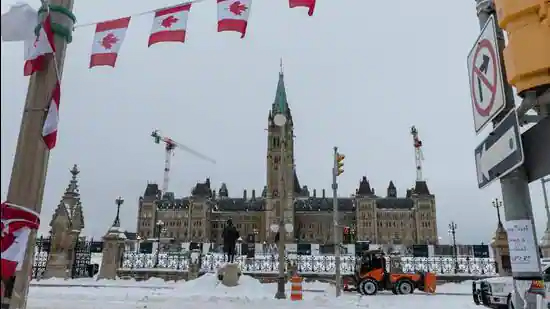
The occupation of Ottawa, which began on January 28, is almost completely over, with only stragglers from the Freedom Convoy 2022 remaining, but without their vehicles, as law enforcement started removing checkpoints erected to prevent access to the downtown core including Parliament Hill.
The Liberals are in a minority in the House and needed support for passage of the motion, which was supplied by the NDP. While its leader Jagmeet Singh had consistently supported protesters against the farm laws in India, he turned out a staunch supporter of Trudeau in crushing the civil obedience in Canada, and followed the ruling party line.
The motion needs to be affirmed by the Senate, but that appears to be a formality. The emergency, which has witnessed extreme action including freezing of bank accounts, will be in force for 30 days since it was imposed.
At least two Liberal MPs voiced concern over the emergency but voted for the motion as otherwise a loss for the government would have been construed a vote of no confidence precipitating elections just about five months since the last in 2021.
Canada’s leading civil rights organisation, the Canadian Civil Liberties Association (CCLA) again called for revoking the emergency. “We are deeply disappointed the government chose to make tonight’s vote a matter of confidence,” it said, in a tweet. It said it had asked the government, at minimum, a free vote, and MPs, in public and in private had said “that they would vote against the emergency declaration if given a chance”.
Despite the protests largely being subdued, there was little clarity on when the government will give up the extraordinary powers it has assumed. Speaking to reporters on Monday morning Trudeau said, “Even though the blockades are lifted across border openings right now, even though things seem to be resolving very well in Ottawa, this state of emergency is not over.”
Despite demonising protesters since the civil obedience began, Trudeau sounded a conciliatory note after the motion passed, as he tweeted, “There’s no doubt the past few weeks have been difficult, that the past few years have been painful, or that there are still challenges we’ll have to face. But we cannot allow anger to divide us. Now is the time to work together – and to start healing as a nation.”
The opposition was not buying his remarks, as Pierre Poilievre, favoured to become the next leader of the principal Opposition Conservatives, tweeted, “The real emergency is government overreach.”
The emergency still awaits judicial review, as court challenges, including one filed by CCLA, remain.
Meanwhile, Ontario’s special investigative unit, a police oversight body, is looking into instances of alleged police misconduct in Ottawa during the operation to evict protesters, including trampling of protesters and use of non-lethal arms.
The Ottawa Police Service has, so far, arrested 196 persons, most released with a warning, filed charges against 110, mostly on minor counts, and towed 115 vehicles.